How to Choose the Right Aircon for Your HDB or Condo
Buying a new aircon for your HDB flat or condo in Singapore? Compare split, multi-split, and system types. Expert recommendations by room size.
We often see homeowners overwhelmed by technical jargon when figuring out How to Choose the Right Aircon for Your HDB or Condo. The SP Group electricity tariff currently sits at 29.11 cents per kWh with GST for the first quarter of 2026. This high rate makes energy efficiency a serious financial priority for Singapore households.
Our team relies on over two decades of aircon servicing in Singapore and aircon installation experience to help families avoid costly sizing mistakes. A smart setup balances your upfront budget against long-term running costs.
Let’s look at the critical data behind sizing your units, understanding structural regulations, and choosing the best brand for your layout.
System Types Explained
Before picking a brand, you must match the system architecture to your specific property type. HDB regulations dictate what you can actually install on your exterior walls. Our technicians always check your flat’s electrical load capacity before recommending a configuration.
Older flats built before 1994 typically feature a 30-Amp main switch. This older infrastructure strictly limits you to an outdoor unit weight of 80kg. Newer properties or those upgraded under the Home Improvement Programme carry a 40-Amp main switch. This upgraded power supply comfortably handles larger multi-split systems with condensing units weighing up to 110kg per wall panel.
Single Split (System 1)
One indoor unit connects directly to a single outdoor compressor. This direct connection offers reliable cooling for a targeted area. We usually suggest this setup for spaces where expanding the ductwork makes little sense. A dedicated compressor means a fault in this unit will not affect the rest of your home.
Best for: Studio apartments, single bedrooms, or small offices.
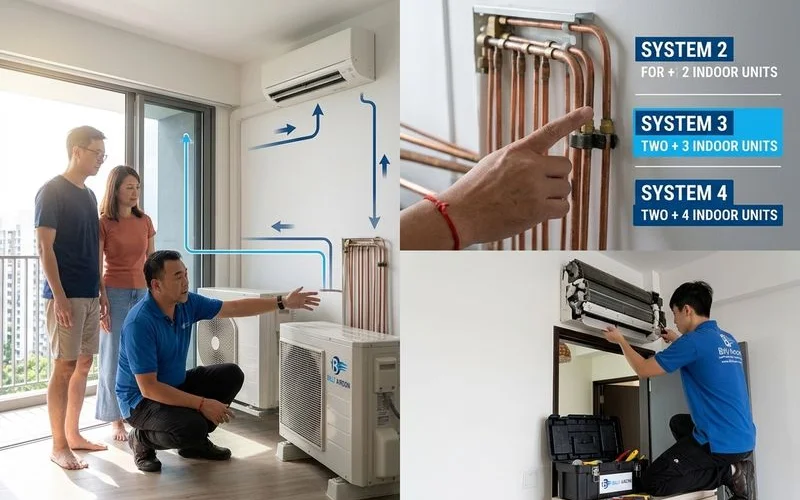
Multi-Split (System 2, 3, 4, 5)
Multiple indoor units connect to a shared outdoor compressor. Consolidating the exterior hardware saves precious ledge space in modern high-rises. Our installation crews install these shared systems daily across residential estates.
Running three or four indoor units off one condenser requires careful calculation of the total running current. The Building and Construction Authority strictly requires all installations to use a 20-amp double pole isolator or a 15-amp power point to prevent electrical fires.
Best for: HDB flats and condos where you want aircon in multiple rooms.
| System | Indoor Units | Typical Use |
|---|---|---|
| System 2 | 2 units | 3-room HDB, 2-bedroom condo |
| System 3 | 3 units | 4-room HDB, 3-bedroom condo |
| System 4 | 4 units | 5-room HDB, large condo |
| System 5 | 5 units | Executive apartments, large homes |
How to Choose the Right Aircon for Your HDB or Condo: Sizing Your BTU
Cooling power is measured in British Thermal Units (BTU). Selecting the exact rating ensures your room cools rapidly without overworking the compressor. Our sizing calculations account for Singapore’s intense afternoon heat and high humidity levels.
An undersized 9,000 BTU unit in a large living room will run constantly. This constant strain drives up your utility bill while failing to reach the target temperature. Oversized units cool the air too fast without removing enough humidity, leaving your room feeling clammy.
Here is a practical sizing guide for typical Singaporean floor plans:
| Room Size | Recommended BTU |
|---|---|
| Small bedroom (80-100 sq ft) | 9,000 BTU |
| Master bedroom (100-150 sq ft) | 12,000 BTU |
| Living room (150-250 sq ft) | 18,000-24,000 BTU |
Environmental factors play a massive role in actual cooling performance. We strongly advise adjusting these baselines based on your block’s orientation. West-facing walls absorb harsh afternoon sunlight and transfer that heat indoors until late evening.
Adjustments for Singapore:
- West-facing rooms: add 10-15% BTU
- High floor with sun exposure: add 10% BTU
- Ground floor or shaded: standard BTU is fine
Inverter vs Non-Inverter
Standard non-inverter compressors operate on a simple stop-start cycle. The motor runs at full blast until the room reaches the set temperature, shuts off completely, and then surges back to life when the room warms up. Our energy audits show this constant surging draws massive amounts of electricity. Inverter technology solves this problem by using a variable-speed compressor.
The motor simply slows down to maintain a steady temperature once the room is cool. We strongly recommend investing in a 5-tick inverter system for three distinct reasons:
- Lower Running Costs: Cuts energy consumption by 30% to 50%.
- Quieter Operation: Eliminates the loud click and hum of the compressor kicking on.
- Consistent Comfort: Prevents the room from shifting between freezing and warm.
The National Environment Agency (NEA) raised its Minimum Energy Performance Standards in 2026. These highly efficient models are now the benchmark for new installations. Homeowners can offset the initial cost using government subsidies.
All HDB households can claim $300 in Climate Vouchers until December 2027 for eligible 5-tick units. Our installation coordinators guide customers through claiming these rebates to maximize their savings.
Top Brands for Singapore
Selecting a reliable manufacturer ensures you have access to spare parts and qualified technicians for the next decade. Certain models perform better in specific environments based on their engineering priorities. Our maintenance logs from thousands of service calls highlight clear leaders in the local market. Daikin and Mitsubishi consistently dominate residential installations due to their proven durability in tropical climates.
Noise levels are a critical deciding factor for bedrooms. The Mitsubishi Starmex series operates at an incredibly quiet 19 decibels on its lowest fan setting, which is softer than rustling leaves. We point light sleepers toward these specific units for uninterrupted rest. Daikin’s iSmile series follows closely at 21 decibels while offering excellent smart-home integration right out of the box.
Here is a breakdown based on field experience with thousands of units:
| Brand | Strengths | Popular Model |
|---|---|---|
| Daikin | Quiet operation, energy efficient | iSmile Series |
| Mitsubishi | Reliable, wide service network | Starmex |
| Panasonic | nanoe air purification | Econavi Series |
| LG | Dual Inverter, value for money | Dual Inverter |
R32 vs R410A Refrigerant
The cooling gas circulating inside your piping dictates the environmental impact of your system. Older legacy units rely on R410A gas, but the industry has officially shifted to a superior alternative. Newer models now use R32 refrigerant exclusively. This modern compound is roughly 10% more energy-efficient and carries a significantly lower global warming potential.
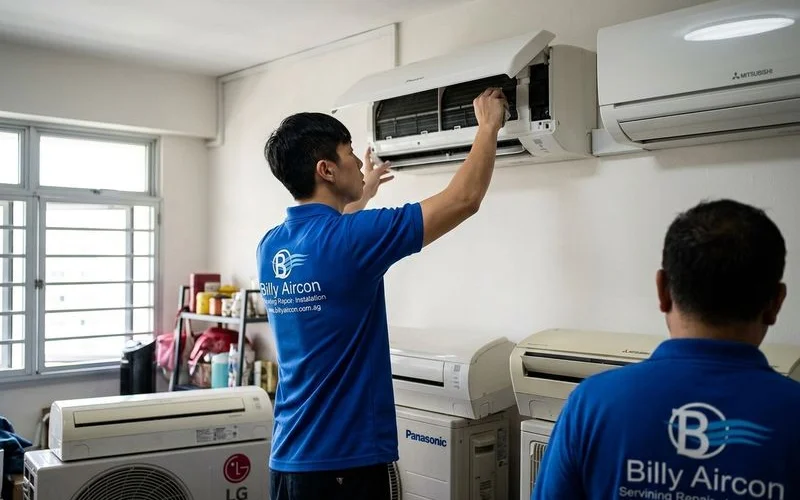
Handling this newer gas requires specialized training and certified equipment. Our technicians complete rigorous safety courses to manage these high-pressure systems safely inside residential blocks. Regulatory bodies prefer R32 for all new installations.
Our team is fully licensed for R32 handling and ready to upgrade your property. This proactive choice ensures your hardware complies with future environmental regulations.
Ready to Install?
Skipping the technical assessment often leads to hidden structural issues down the road. A professional site survey confirms your electrical capacity and maps out the most efficient piping routes. Proper insulation around your copper piping also plays a big role in long-term efficiency.
Our BCA-trained technicians evaluate your specific floor plan to recommend a compliant and cost-effective system. You do not have to figure out HDB regulations or BTU calculations alone.
The right guidance saves you from buying an oversized unit or failing a structural inspection. Figuring out How to Choose the Right Aircon for Your HDB or Condo ensures your daily comfort.
We invite you to WhatsApp us directly or explore our full installation page to book your assessment. After installation, regular servicing every three to four months keeps your utility bills permanently low.

Written by
PhilipsChief Technical Leader
Founder of Billy Aircon with 25 years of aircon servicing experience in Singapore.
Need Professional Aircon Help?
Our team of 26 experienced technicians is ready to help. 90-day warranty on all services.
WhatsApp for Instant Quote