How Often Should You Service Your Aircon in Singapore?
Find out the ideal aircon servicing frequency for Singapore's tropical climate. Expert recommendations for HDB, condo, and landed homes.
If you are wondering how often should you service your aircon in Singapore?, the answer is less about basic maintenance and more about active climate defense.
The constant battle against high humidity and year-round heat means standard temperate-climate advice simply does not apply here. We started Billy Aircon back in 2003 with just a team of five. Since growing to 26 dedicated specialists, providing reliable aircon servicing in Singapore has remained our primary mission. That hands-on history has shown us exactly how fast a system can degrade without a proactive schedule.
Let’s look at the hard data behind optimal service intervals, explore what actually happens inside your unit, and map out a practical maintenance strategy.
How Often Should You Service Your Aircon in Singapore? The 3-4 Month Rule
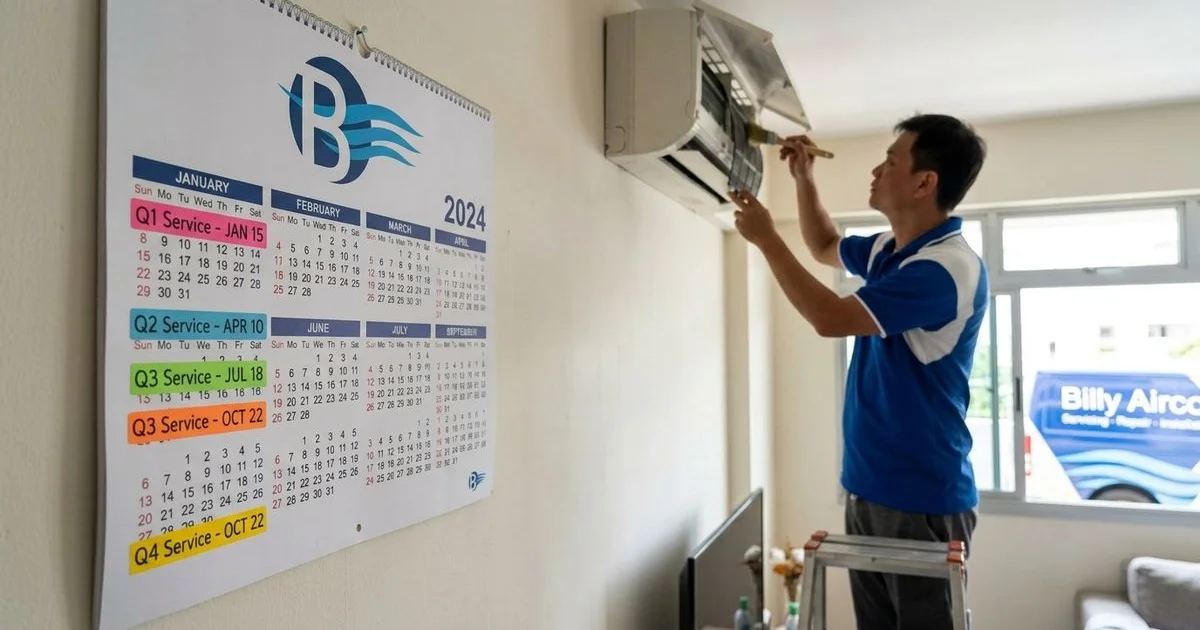
For most Singapore homes, whether HDB, condo, or landed, the sweet spot for routine maintenance is every 3-4 months. This quarterly schedule keeps your system running efficiently without over-servicing.
Our team aligns this recommendation directly with 2026 National Environment Agency (NEA) guidelines for maintaining Minimum Energy Performance Standards (MEPS). Units that skip this 90-to-120-day window quickly lose their energy-efficient tick ratings.
Leading manufacturers like Daikin and Mitsubishi also suggest this 3-4 month baseline to protect sensitive evaporator coils from premature wear.
Routine quarterly servicing is the dividing line between a system that lasts 5 years and one that runs flawlessly for 15.
Why Singapore Needs More Frequent Servicing
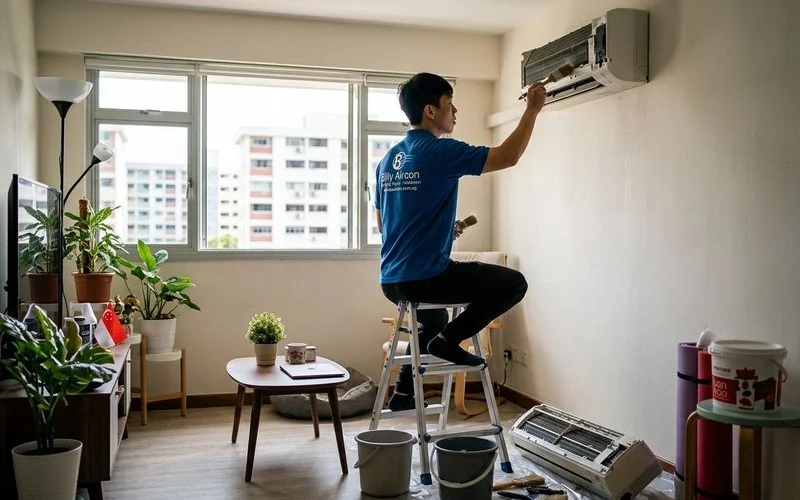
Singapore’s unique tropical climate creates specific conditions that rapidly accelerate mechanical wear. Understanding these environmental triggers helps explain why a proactive schedule is non-negotiable.
Three Primary Wear Factors
- Excessive Moisture: The island’s relative humidity averages 82% year-round. This constant wetness encourages rapid growth of specific moulds like Aspergillus on dark, damp indoor coils.
- Constant Operation: Local systems endure a 365-day operational cycle, often running 8 to 16 hours daily. This heavy duty cycle stresses moving parts much faster than seasonal use.
- Urban Particulates: Fine dust (PM2.5) from busy roads quickly clogs standard mesh filters. A blocked filter reduces airflow and forces the blower motor to strain against the restriction.
Our field data shows that combining these three factors halves the effective lifespan of untreated components. Routine cleaning disrupts this wear cycle before permanent damage occurs.
Servicing Frequency by Usage
Not every household requires the exact same maintenance timeline. Your ideal schedule depends heavily on your daily operational hours.
We use a simple hours-based metric to categorize usage levels and assign the correct interval. Matching your habits to this chart prevents both wasteful over-servicing and dangerous neglect.
| Usage Level | Hours Per Day | Recommended Frequency | Specific SG Context |
|---|---|---|---|
| Light | 4-6 hours | Every 4-6 months | Guest rooms or occasional-use study areas |
| Normal | 8-12 hours | Every 3-4 months | Typical HDB/Condo bedrooms used for sleeping |
| Heavy | 12+ hours | Every 2-3 months | Living rooms or home offices in constant use |
| Commercial | 16+ hours | Monthly | Retail shops and offices exposed to high traffic |
Commercial spaces face the highest particulate loads due to constant door openings. These heavy-duty environments must adhere to strict monthly schedules to avoid unexpected daytime breakdowns.
What Happens If You Skip Servicing?
Neglecting regular servicing triggers a chain reaction of increasingly expensive problems. The timeline of degradation is highly predictable in our tropical environment.
We have tracked hundreds of breakdown cases to map out exactly how these failures progress over a year.
The 12-Month Breakdown Timeline
- Month 1-3 (Rising Bills): Dirty filters immediately choke airflow. This forces the system to consume more power, increasing your electricity bills by 5-15%. With the Q1 2026 SP Group tariff at roughly 29.11 cents per kWh (with GST), this inefficiency adds up fast.
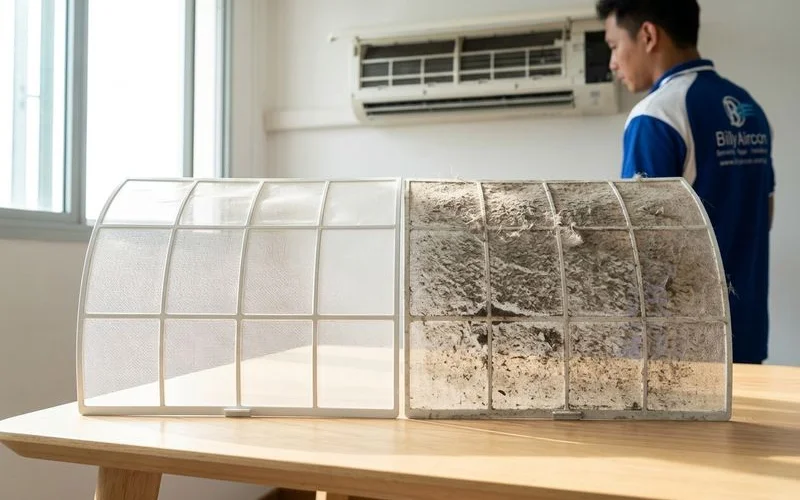
- Month 4-6 (Biological Growth): Bacteria and mould colonise the evaporator coil. This buildup produces a distinct musty smell and degrades indoor air quality.
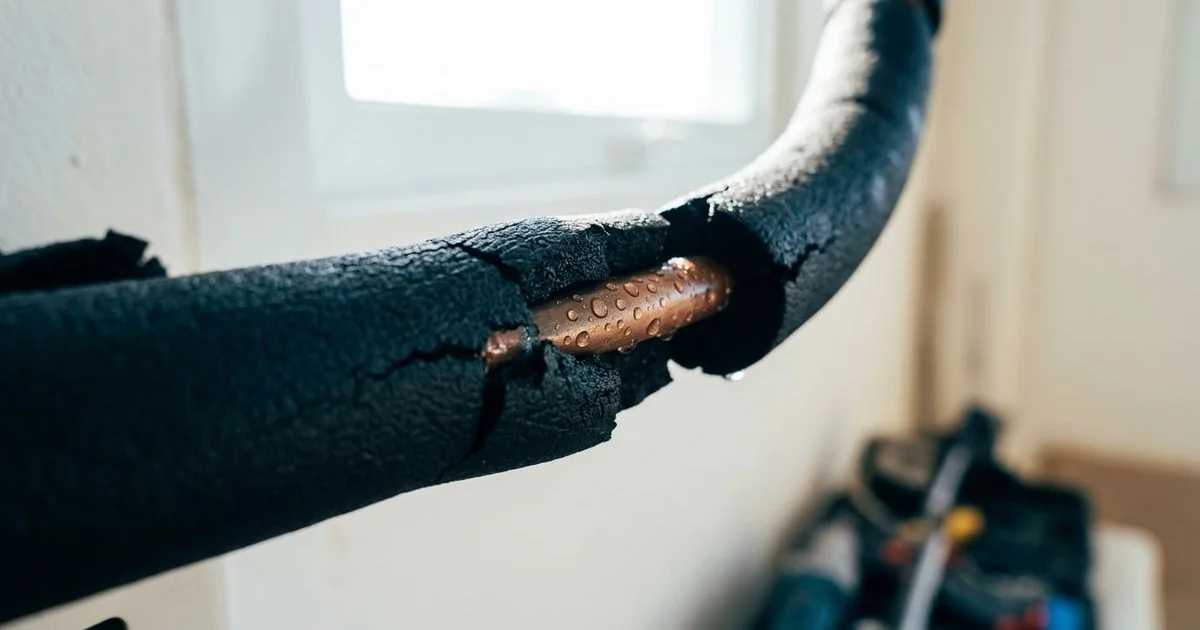
- Month 6-9 (System Blockages): The condensate drain pipe clogs with a mix of dust and algae jelly. This backup is the number one cause of indoor water leaks.
- Month 9-12 (Severe Inefficiency): Cooling capacity drops drastically. At this stage, a basic wipe-down is insufficient, and you will likely need a full chemical wash to strip the hardened grime.
Leaving a unit untreated beyond the two-year mark places massive strain on the compressor. Replacing a burnt-out compressor on premium brands like Daikin or Mitsubishi currently averages between $600 and $1,200 in Singapore.
Our goal is to help you avoid these massive repair bills through simple preventative care. Watch for the early signs your aircon needs repair so you can act before a small problem becomes costly.
Annual Service Contracts Save Money
Booking individual appointments usually costs more in both time and service fees. Committing to a structured plan secures better rates and guarantees priority scheduling.
Our annual service contracts include four quarterly visits at a significantly discounted rate. A standard ad-hoc service in Singapore typically ranges from $30 to $60 per unit.
By choosing a 3-unit contract for $240 per year, your cost drops to just $20 per unit, per visit.
Comparing Your Options
| Service Type | Cost Per Unit (Approx) | Long-Term Benefit |
|---|---|---|
| Ad-Hoc Basic Service | $30 - $60 | Fixes immediate issues |
| Ad-Hoc Chemical Wash | $30 - $45 | Deep cleans severe neglect |
| Annual Contract (3 Units) | $20 per visit | Prevents major breakdowns |
This structured approach ensures your system remains operating at its peak 5-tick NEA efficiency rating. You can view our complete pricing online to compare all available packages.
Book Your Servicing Today
Do not wait for a hot afternoon breakdown to realise your system needs attention. When neighbors ask how often should you service your aircon in Singapore?, you now know that staying ahead of the maintenance curve is the most logical way to protect your home cooling investment.
Regular aircon servicing is the most cost-effective method to keep your electricity bills low and your indoor air fresh. We are ready to help you set up a hassle-free maintenance schedule.
Simply WhatsApp us right now to book your next appointment and secure your preferred time slot.

Written by
PhilipsChief Technical Leader
Founder of Billy Aircon with 25 years of aircon servicing experience in Singapore.
Need Professional Aircon Help?
Our team of 26 experienced technicians is ready to help. 90-day warranty on all services.
WhatsApp for Instant Quote